A cross-sector study by KWB and Ecologic Institute commissioned by the German Environment Agency
Water-saving technologies are widely available. But which measures are feasible under real-world conditions, and when do water resources actually benefit? On behalf of the German Environment Agency, the Berlin Centre of Competence for Water (KWB) and Ecologic Institute are investigating water-saving potential across different sectors and assessing the associated environmental impacts.
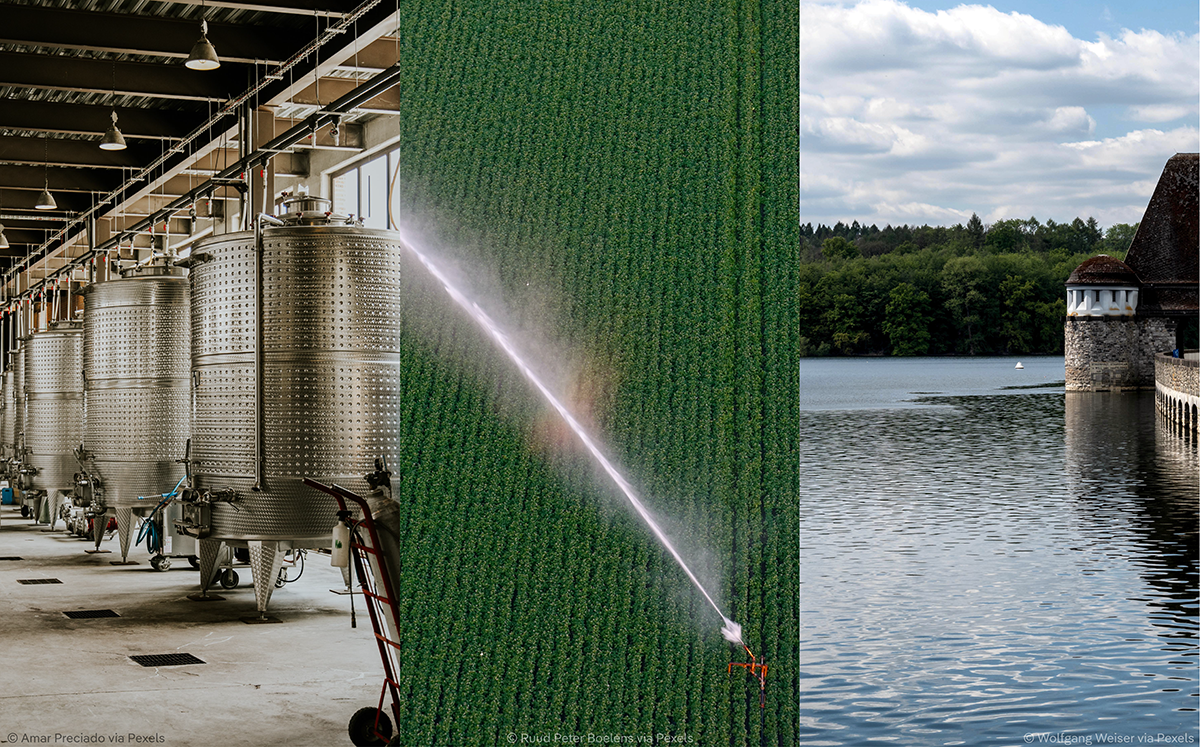
Industry, agriculture and public water supply all depend on reliable access to water. Yet as dry periods become more prolonged and competition for water resources intensifies, the question of how to use available water more efficiently is becoming increasingly urgent.
Considerable progress has been made in improving water-use efficiency over recent decades. Nevertheless, significant untapped potential remains across industry, agriculture and public water supply. Opportunities range from water recycling and reuse in industrial processes to more efficient irrigation systems, reduced losses from water distribution networks and improved demand management in public water supply.
Commissioned by the German Environment Agency (UBA), the Berlin Centre of Competence for Water (KWB) and Ecologic Institute are investigating opportunities to improve water-use effi-ciency in industry, including the energy sector, agriculture and public water supply. The project aims to identify technical solutions and untapped water-saving potential, assess their practical feasibility and environmental impacts, and develop recommendations for more sustainable water use in Germany.
The study supports the implementation of Germany's National Water Strategy, particularly its objective of promoting more efficient water use. It also complements KWB's work on the project “Methodology for Evaluating the National Water Strategy”, in which KWB and its partners are developing an approach to assessing progress in implementing the strategy.
Taking a Comprehensive Approach to Water-Use Efficiency
At the heart of the project is the question of how existing water resources can be used more efficiently and which technical, economic and regulatory conditions are needed to achieve this. The research team is examining current water-use practices and the state of the art in all three sectors, identifying untapped opportunities to save water and assessing their practical feasibility.
The research focuses on four key areas:
-
Water use and the state of the art: Documenting and comparing current water-use practices, along with technical and organisational measures to improve water-use efficiency.
-
Water-saving potential and environmental impacts: Identifying and estimating potential water savings while considering environmental impacts and possible rebound effects.
-
Regional challenges: Analysing where areas experiencing water stress overlap with high water demand and examining the conditions affecting implementation at regional level.
-
Enabling conditions and recommendations: Assessing technical, economic and regulatory barriers and incentives, and developing recommendations to help realise untapped water-saving potential.
Bringing Practical Experience into the Research
Engaging with stakeholders and drawing on practical experience is an integral part of the project. Three specialist workshops are planned, focusing on industry, including the energy sector, agriculture and public water supply.
Representatives from industry, research, public administration and professional associations will discuss innovative technologies, opportunities to save water and challenges to implementation. The insights gained will inform the research and contribute to the development of practical recommendations.
Building the Evidence Base for Future-Proof Water Management
The project findings will provide a scientific basis for further developing water-efficiency standards, economic incentives and water demand management instruments. They will help identify where the greatest opportunities to save water lie and how these can be more effectively realised.
The findings are also relevant to Berlin and Brandenburg. Prolonged dry periods and competing demands for water are increasing the need for forward-looking management of available water resources. By examining water-use efficiency across Germany, the project can help put poten-tial courses of action for the capital region into perspective and inform the development of measures for more efficient, climate-adapted water use.
Project Lead (KWB): Nasrin Haacke
Project Lead


